
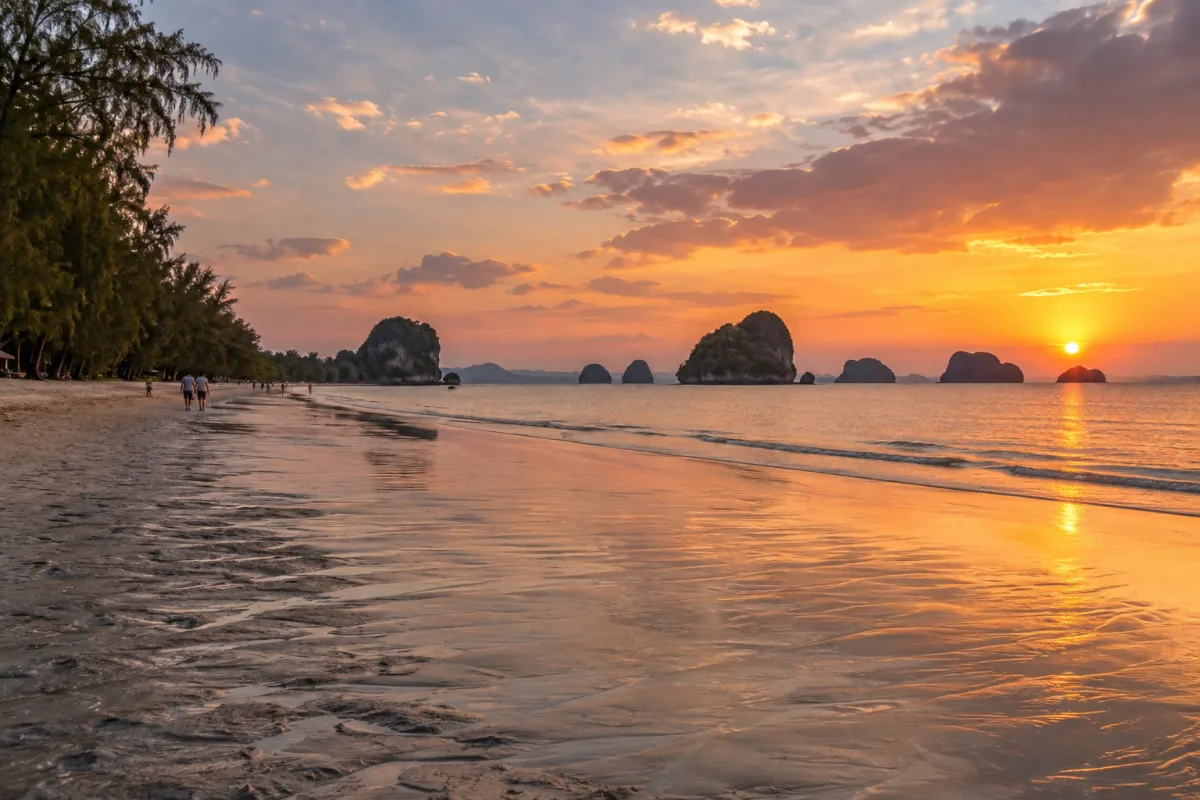
Noppharat Thara Beach is a long, gently sloping beach beside Ao Nang in Krabi Province. Part of Hat Noppharat Thara–Mu Ko Phi Phi National Park, it is known for casuarina shade, broad intertidal flats, views of small offshore islands and sunsets over the Andaman Sea.
Why visit Noppharat Thara Beach?
The beach offers a quieter, more spacious coastal setting than the busiest section of neighboring Ao Nang. Its approximately three-kilometre shoreline combines sandy stretches, shaded areas and shallow water, while the western end is associated with the national park and an estuarine landscape.
Noppharat Thara changes character throughout the tidal cycle. At higher water, the sea reaches farther across the gently sloping shore. At low tide, broad areas of wet sand, shallow channels and tidal flats appear, creating reflections and revealing the scale of the intertidal zone.
Where is Noppharat Thara Beach?
The beach lies in Ao Nang Subdistrict, Mueang Krabi District, immediately northwest of Ao Nang’s main beachfront area. It is on the mainland and can be reached by road, unlike Railay and many of Krabi’s islands, which require boat access.
The surrounding area includes accommodation, local businesses and marine transport facilities. The exact atmosphere varies along the shoreline: some sections feel more connected to town, while others have more trees, open sand and national-park character.
What makes the low tide special?
Noppharat Thara’s shallow coastal profile allows the sea to retreat a noticeable distance. In suitable conditions, exposed sand extends toward small offshore islets, including the area near Ko Khao Pak Klong. The result is one of the beach’s most recognizable scenes.
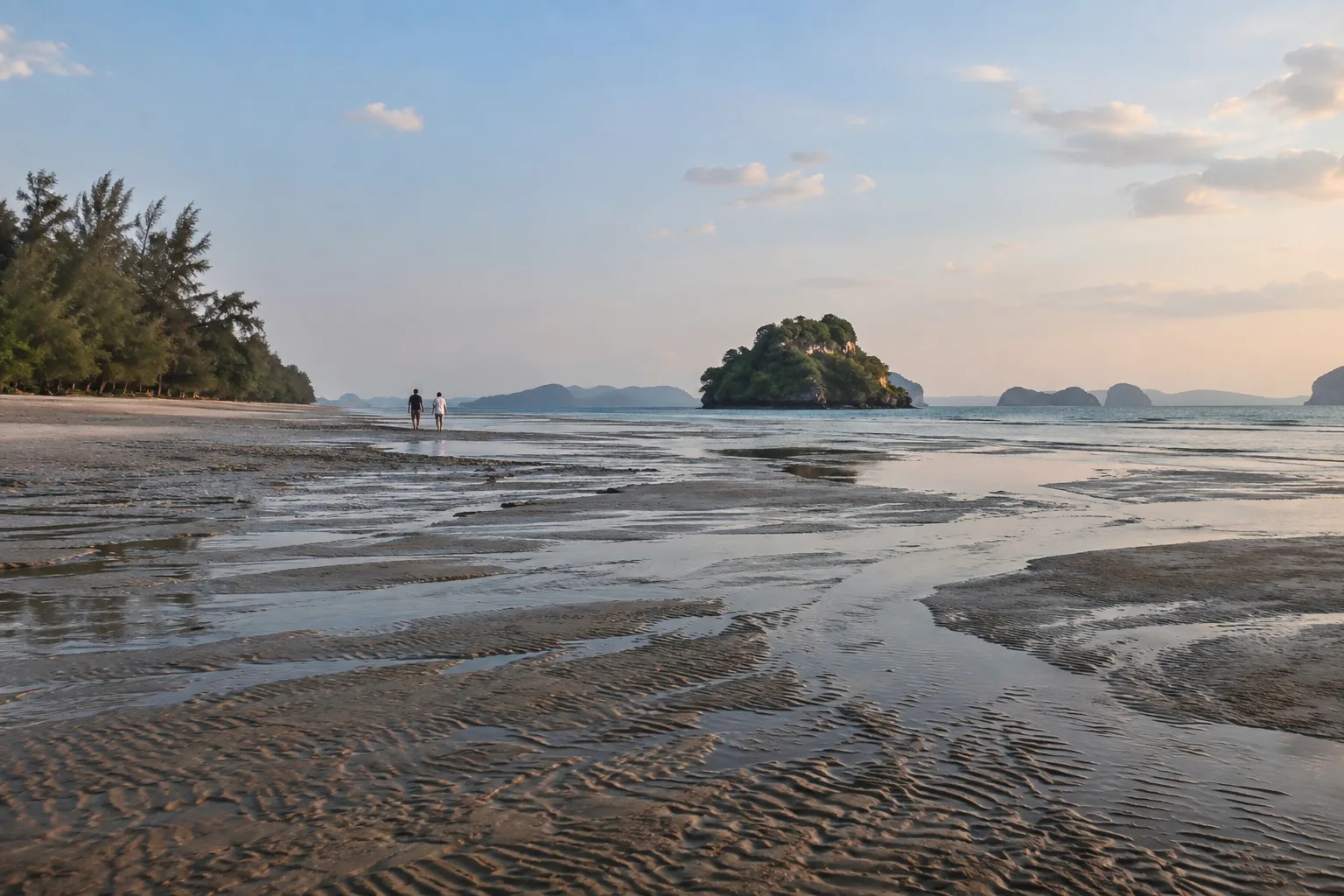
A visible sandflat is not a guarantee that every route is safe to walk. Channels may remain deep or become refilled as the tide turns, and soft sediment can be uneven. Check a reliable local tide forecast, observe conditions and return well before rising water cuts off the route.
Best things to do
- Walk along the firm part of the shoreline and watch the tidal landscape change.
- Relax beneath the casuarina trees without damaging roots or coastal vegetation.
- Photograph the offshore islets and reflections across the wet sand.
- Watch the sunset when weather and cloud cover allow.
- Enjoy a picnic while securing all packaging against wind.
- Observe shorebirds and small intertidal life from a respectful distance.
- Use the area as a starting point for an authorized boat trip when a suitable service is operating.
Is Noppharat Thara good for swimming?
Swimming is possible when local conditions are suitable, but the experience depends heavily on the tide. Low water may leave a long, shallow approach with exposed sand and channels. At other times, waves, currents, weather or boat activity may make entering the water inappropriate.
Look for current warning signs and follow instructions from national park staff or local authorities. Children and inexperienced swimmers require close supervision, even where the water appears shallow. Do not swim in navigation areas, near moving boats or in an estuary with a visible current.
When to visit
The right time depends on the experience you want. Higher water presents a more conventional seascape, while lower water exposes the beach’s tidal flats. Late afternoon is popular for softer light and sunset, but clouds and rain can alter the view in every season.
Krabi generally experiences drier conditions from November through April and a wetter southwest-monsoon influence during other months. These are broad seasonal patterns, not daily guarantees. Check the weather, marine forecast and tide before visiting.
How to get there
Because Noppharat Thara is on the mainland, visitors can approach by road from Ao Nang, Krabi Town and other parts of the province. Local transport options vary, so confirm the destination and return arrangements before departure rather than relying on a fixed timetable.
Noppharat Thara also functions as one of Krabi’s marine departure areas. Ferry and tour operations can change with season, weather and regulation. Travelers continuing by sea should confirm the precise pier, check-in point and current service directly with the operator.
Noppharat Thara or Ao Nang Beach?
- Choose Noppharat Thara for a longer shoreline, shaded areas, tidal flats and a more local picnic atmosphere.
- Choose Ao Nang for closer access to the central tourism district and its concentrated services.
- Visit both if you want to compare two neighboring beaches with different coastal characters.
- Do not judge swimming quality by the beach name alone; assess the actual tide and conditions.
What to bring
- Sun-protective clothing, a hat and sunglasses
- Drinking water in a reusable bottle
- Footwear suitable for hot sand, shells and uneven tidal surfaces
- A dry bag or splash-resistant case for electronics
- Insect repellent for shaded or estuarine areas
- A small bag for taking all personal waste away
- A downloaded tide forecast if mobile reception or data becomes unreliable
Responsible beach etiquette
The beach belongs to a protected national-park landscape and contains living intertidal habitat. Small crabs, molluscs, shorebirds and other wildlife depend on the sandflats and coastal vegetation. Observe them without collecting, feeding, chasing or disturbing them.
- Take all rubbish, food containers and cigarette ends away.
- Avoid single-use plastics that can be carried into the sea by wind.
- Do not remove shells, animals, plants or natural material from protected areas.
- Keep noise low around wildlife and other beach users.
- Do not drive or park on the sand unless an area is expressly designated.
- Respect barriers, signs and temporary closures.
- Use authorized boat operators and never encourage anchoring on sensitive marine habitat.
Photography tips
Low tide creates leading lines, rippled sand and mirror-like pools, while higher water simplifies the scene into sea, sky and island silhouettes. A wide-angle view captures the scale of the flats; a longer lens can isolate distant islets and the setting sun. Keep cameras secured against sand, spray and sudden rain.
Frequently asked questions
Is Noppharat Thara Beach inside a national park?
Yes. The beach forms part of Hat Noppharat Thara–Mu Ko Phi Phi National Park, which protects mainland coastal habitats as well as islands and marine areas.
Can you walk to the offshore islands?
Exposed sand may provide access toward nearby islets during a sufficiently low tide, but conditions vary. Check the tide, currents and official guidance before attempting the walk, and turn back before the water begins to rise.
Is the beach suitable for families?
The open shoreline and shaded sections can suit a family outing, but adults must supervise children around water, boats, tidal channels and traffic near access points. Shallow-looking water should not be assumed to be risk-free.
Can you see sunset from Noppharat Thara?
The beach faces the Andaman coast and is widely visited for evening views. The exact position and visibility of the sun depend on the season, clouds and weather.
Are there shops and restaurants nearby?
Developed sections around Noppharat Thara and Ao Nang have local services, but availability differs along the beach and can change. Carry essential water and confirm current options rather than assuming facilities are present at every access point.
Planning checklist
- Check the tide and weather for the date of your visit.
- Choose a beach access point suited to your planned activity.
- Bring sun protection, water and appropriate footwear.
- Obey park signs and assess swimming conditions on arrival.
- Stay clear of navigation routes and moving boats.
- Leave the sandflats, vegetation and wildlife undisturbed.
- Take every item of waste away with you.